IELTS vs. TOEFL: Which English Proficiency Test Should You Take?
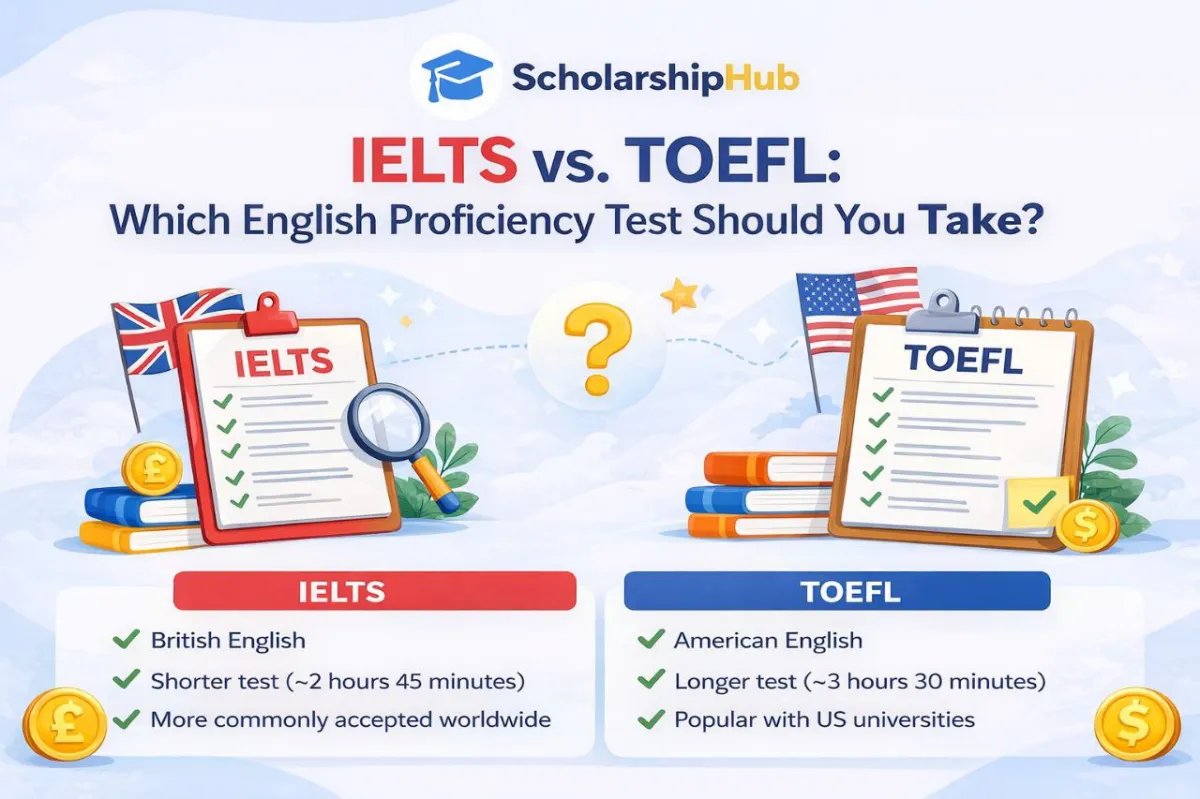
If you are an international student applying for a fully funded scholarship in an English-speaking country (or a program taught in English), you will almost certainly need to prove your language skills. The two biggest names in the game are IELTS and TOEFL.
Both tests are globally recognized, both measure your Reading, Listening, Speaking, and Writing abilities, and both cost around $200 USD. So, how do you choose?
In this guide, we will break down the exact differences between the IELTS and the TOEFL to help you decide which test format will give you the highest possible score.
The Basics: IELTS vs. TOEFL
IELTS (International English Language Testing System): Historically favored by the UK, Australia, New Zealand, and Canada. However, it is now accepted by over 3,400 institutions in the USA. You can choose to take it on a computer or on paper.
TOEFL (Test of English as a Foreign Language): Historically favored by American universities. The most common version is the TOEFL iBT (Internet-Based Test), which is taken entirely on a computer.
The Biggest Difference: The Speaking Section
This is usually the deciding factor for most students.
The IELTS Speaking Test (Face-to-Face)
In the IELTS, your speaking test is conducted in person with a real human examiner. It feels like a normal conversation. It takes about 11–14 minutes and is often scheduled on a different day than your main test.
- Pros: If you are a social person who feels comfortable talking to humans, this feels much more natural. You can read the examiner's body language and ask them to repeat a question if you didn't hear it.
The TOEFL Speaking Test (Microphone)
In the TOEFL, you will speak into a microphone connected to your computer. You will hear a recorded question, get a few seconds to prepare, and then the computer will record your answer.
- Pros: If you get nervous talking to strict examiners or authoritative figures, talking to a screen might relieve your anxiety.
- Cons: You are usually in a room full of other test-takers who are also speaking into their microphones at the same time, which can be highly distracting.
Reading & Writing: Multiple Choice vs. Mixed Formats
Reading: The TOEFL reading section is almost entirely multiple-choice. The IELTS reading section is highly varied—you will have to fill in blanks, match headings to paragraphs, write short answers, and answer tricky "True/False/Not Given" questions.
Writing: For the TOEFL, you must type your essays on a standard computer keyboard. If you type quickly, this is a huge advantage. For the IELTS, you can choose to take the computer-delivered test (typing) or the traditional paper-based test (handwriting). If you prefer writing with a pencil, IELTS is your only option.
Scoring Systems Explained
- TOEFL: Scored out of 120 points (30 points for each of the four sections). Most top-tier universities require a score of 90 to 100+.
- IELTS: Scored on a band system from 0 to 9. You get a band score for each section, and an overall average. Most master's programs require an overall band of 6.5 or 7.0.
Want to skip the English test entirely?
Did you know that some world-class universities do not require IELTS or TOEFL if you can prove your previous degree was taught in English?
Check this out: Discover Fully Funded Italian Scholarships Without IELTS Requirements!
Final Verdict: Which one is easier?
Neither test is objectively "easier"—they just test your English in different ways.
Choose TOEFL if: You type very fast, you prefer answering multiple-choice questions, you are applying primarily to American universities, and you get nervous talking face-to-face with examiners.
Choose IELTS if: You prefer handwriting, you struggle with strict multiple-choice questions, you want a more natural conversational speaking test, and you are targeting the UK, Europe, or Australia.
Whichever test you choose, start preparing early! Once you have your language scores, make sure your application is flawless by downloading our free CV and essay templates from the ScholarshipHub Resources Center.